AI and the job market: Robot apocalypse or rescue mission?
Ein mächtiger Roboter schiebt einen Arbeiter beiseite – die Angst vor dem "Ende der Arbeit" begleitet den technologischen Wandel schon seit Jahrzehnten. Doch was sagen die aktuellen Fakten wirklich? Ein Blick auf Chancen und Strategien im KI-Zeitalter.
Von Martin Salwiczek · 2026-03-16
Einleitung
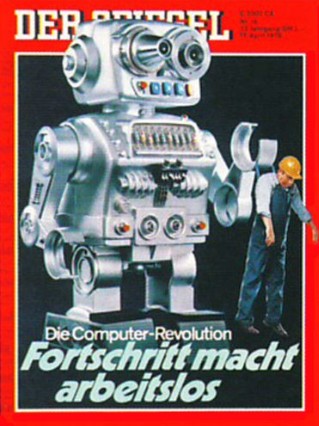
Cover: DER SPIEGEL, Ausgabe 17/1978, Titel „Die Computer-Revolution – Fortschritt macht arbeitslos". © DER SPIEGEL / SPIEGEL-Verlag Rudolf Augstein GmbH & Co. KG. Verwendung gemäß § 51 UrhG (Bildzitat) im Rahmen einer inhaltlichen Auseinandersetzung.
Ein mächtiger, metallischer Roboter schiebt einen Arbeiter im Blaumann unsanft beiseite. Die Szene wirkt wie eine düstere Prophezeiung unserer unmittelbar bevorstehenden Zukunft, in der menschliche Arbeit scheinbar keinen Platz mehr findet. Die Schlagzeile dazu ist eindeutig: „Fortschritt macht arbeitslos". Viele Leser würden heute, angesichts der rasanten Entwicklung von ChatGPT und Co., schwören, dass es sich um eine aktuelle Analyse der gegenwärtigen Lage handelt.
Die überraschende Auflösung: Es ist the cover of DER SPIEGEL from April 17, 1978. Even back then, the fear of the 'end of work' accompanied technological change, yet these doomsaying predictions have never come true. A look at today's hard facts reveals a completely different picture: with around 46.1 million employed persons employment in Germany reached a new record high in 2024. Despite this, the pressing question arises again in the face of the new technological wave: AI and the job market: Robot apocalypse or rescue mission?
Shift instead of job apocalypse
---
The good news from the current research of the
Institute for Employment Research (IAB) is: The total number of jobs will remain almost stable over the next 15 years. What we are experiencing, however, is a massive qualitative shift, with around 1.6 million jobs affected by upheaval. The change extends far beyond the office:
Growth champions:
- Agriculture shows particularly dynamic growth, with the number of AI-supported jobs increasing by more than 200% since 2019. Numerous new jobs are also being created in adult education and in the areas of leisure and culture through digital progress and new business models. Efficiency winners:
- Around 110,000 new jobs are being created in the IT sector through infrastructure development. At the same time, work in management consulting and in management is shifting away from data processing towards strategic decisions. Areas under pressure:
- Declines of around 120,000 jobs are expected not only in secretarial roles but also in warehousing and credit reporting agencies, as AI massively accelerates and automates processes here. In the legal and financial sectors, algorithms are also increasingly taking over the manual examination of documents or fraud detection. Special case: Healthcare:
- Although lower employment figures are forecast here, this represents an opportunity: AI-supported diagnostics can relieve pressure on skilled workers and deploy scarce personnel resources where human contact is irreplaceable. What is new is that this change is massively affecting highly qualified expert activities for the first time, which were previously considered safe from automation. However, this does not mean the disappearance of these professions, but rather the liberation from routine tasks to create more complex human decisions.
AI affects everyone: Example: university graduates and low- to mid-skilled workers
---
AI affects everyone: Examples of university graduates and low- to medium-skilled workers
Particularly exciting is the impact on different qualification profiles, which can be seen particularly well from two groups:
1. Focus: University Graduates: Early Responsibility Instead of Routine Start
For young graduates, the picture of career entry is fundamentally changing. Since AI can already take over 93% of classic junior tasks such as data sorting or initial text drafts, the traditional 'apprenticeship years' of support are increasingly disappearing. For newcomers, this means a steep learning curve: roles are becoming more complex and require analytical and strategic thinking much earlier, as well as the ability to critically review and manage AI results.
At the same time, purely formal requirements are decreasing: in AI-exposed positions, only 41% of job advertisements still strictly require a university degree, as practical mastery of the systems and a keen 'adaptation mindset' are becoming more important than the mere certificate. In this new reality, human USPs such as empathy, critical thinking, and social interaction become the most important assets, as they cannot be replaced by technology. As requirements are changing 66% faster today, continuous learning on the system is becoming the new, lifelong prerequisite for professional success.
2. Focus: Low- and Medium-Skilled Workers: New Paths Through AI Assistance
AI also opens new doors for people without an academic degree. Intelligent assistance systems can provide instructions, checklists, and translations in real time, thus significantly lowering the barrier to entry for previously complex tasks. The 'skill leap' is crucial: those who are willing to acquire new, often modular knowledge and use AI tools can reach positions that were previously inaccessible without traditional training.
Furthermore, it is evident that the human touch remains indispensable, especially in nursing, skilled trades, and logistics. AI takes over documentation, routine planning, or warehouse management, while the actual work continues to require human presence and judgment. This creates a new form of division of labor in which technology and humans complement each other rather than displacing each other.
---
AI as a Demographic Lifeline
A look at population statistics shows why the courage to change is necessary despite all the turbulence. By 2040, the German labor market will be short of approximately 0.9 million working individuals due to demographic reasons. AI acts as a crucial bridging function here, helping to secure prosperity and productivity despite a shrinking population. Without this technological progress, the standard of living in an aging society would come under massive pressure.
---
Strategic Classification of the New World of Work
To shape this change successfully, a rethink is needed at all levels:
- At the company level: Small and medium-sized enterprises benefit if they look for an 'adaptation mindset' in recruiting rather than the perfect certificate from past decades. Since only one in five companies currently trains its workforce in a targeted manner, this represents a decisive competitive advantage for those who invest now.
- For job seekers and employees: When choosing further training, practical relevance on the system should be clearly prioritized over the prestigious name of a certificate. Continuously trying out new tools is today the best insurance against structural change.
Those who see AI not as a threat but as an opportunity for personal expansion gain sovereignty in a changing market. Intensive, curious engagement with technology is the decisive lever to not only maintain one's own role in an automated world but to further develop it.
---
How SOLANIUS supports you
We at SOLANIUS support job seekers in building precisely the AI skills that are desperately sought after in today's job market through practice-oriented further training. At the same time, we help companies to specifically qualify their workforce for the digital transformation and to integrate AI applications tangibly into everyday business.
Let's talk. Schedule a free consultation now.
---
Artificial intelligence assisted in the creation of this post – for example, with research, text optimization, and formulation assistance. The idea, structure, and argumentation are by Martin.